

International Diploma in Business with Accounting and Finance
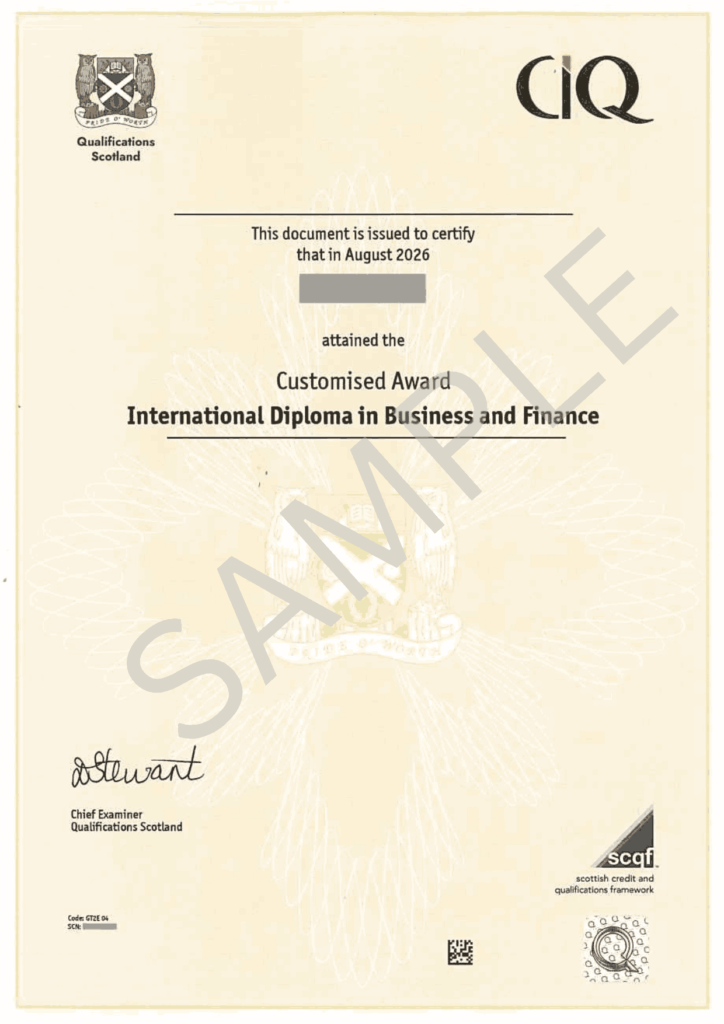
In Partnership with Qualifications Scotland
About International Diploma in Business with Accounting and Finance
The International Diploma in Business with Accounting and Finance is designed to help learners develop practical business, accounting, and financial management capabilities required within modern global organisations. The programme combines core business disciplines with specialised finance and accounting knowledge, enabling learners to explore areas such as economics, project management, analytics, operations, financial analysis, and strategic decision making.
Fee Details
- Program Fee: $9000
- Payment Options: Flexible instalments available
Eligibility
- Completion of higher secondary education or equivalent qualification preferred
- OR
- Relevant academic or professional background subject to eligibility review
- (Advisor guidance available for eligibility assessment.)
- Minimum age: 18 years
- Educational Requirement:
- Completion of Higher Secondary Education or Equivalent
Why Westford Learn?
- Globally Recognised Qualifications Scotland Qualification
- Flexible, Self Paced Learning for Working Professionals
- Industry Relevant, Practical Business Skills
- Study Anytime, from Anywhere with 24/7 Access
- Dedicated Academic Support Throughout
- Strong Career Progression Opportunities
Course Curriculum
Module 1: Academic & Professional Skills Develop academic, communication, and professional skills essential for business and higher education environments.Duration: 4–6 weeks | SCQF Credits: 20
Learning Outcome
- Understand the Harvard Referencing System (HRS) and academic integrity practices
- Develop research and information sourcing skills using library and e-library systems
- Strengthen communication, academic writing, and critical analysis skills
- Create a personal development plan for academic and professional growth
Key Topics
- Harvard Referencing System (HRS)
- Academic writing and critical analysis
- Research and library skills
- Personal development planning
Assessment
- Assignment / Case analysis
Prerequisites
- None
Module 2: Managing People & Organisations Explore the principles of human resource management and organisational effectiveness within business environments.Duration: 4–6 weeks | SCQF Credits: 20
Learning Outcome
- Understand the roles and responsibilities of HR managers within organisations
- Analyse internal and external factors influencing HR decision making
- Evaluate recruitment, performance management, and employee development practices
- Assess the contribution of HR strategies and policies to organisational success
Key Topics
- Human resource management
- Organisational development
- Performance management
- Training and employee engagement
Assessment
- Assignment / Case analysis
Prerequisites
- None
Module 3: Marketing Principles Understand the foundations of marketing, branding, and digital marketing within modern business organisations.Duration: 4–6 weeks | SCQF Credits: 20
Learning Outcome
- Understand the role of marketing within different business organisations
- Apply marketing mix concepts for goods and services
- Analyse the impact of branding, positioning, and marketing strategies
- Evaluate the influence of digital marketing and the e-economy within society
Key Topics
- Marketing strategy
- Brand positioning
- Digital marketing
- Marketing mix concepts
Assessment
- Assignment / Case analysis
Prerequisites
- None
Module 4: Operations & Technology Management Learn how operations and technology management contribute to organisational efficiency and continuous improvement.Duration: 4–6 weeks | SCQF Credits: 20
Learning Outcome
- Apply operations management theories and tools within organisations
- Investigate operational challenges and continuous improvement strategies
- Evaluate the impact of technology on operational performance
- Assess operational efficiency within business contexts
Key Topics
- Operations management
- Process improvement
- Technology integration
- Operational efficiency
Assessment
- Assignment / Case analysis
Prerequisites
- None
Module 5: Economics for Business Gain an understanding of economic principles and their impact on business growth and decision making.Duration: 4–6 weeks | SCQF Credits: 20
Learning Outcome
- Recognise how resource allocation takes place within market economies
- Analyse the impact of competition within business environments
- Evaluate how macroeconomic and microeconomic objectives affect business growth
- Examine the theory and practice of common markets and currency unions
Key Topics
- Market economies
- Business competition
- Macroeconomics and microeconomics
- Common markets and currency unions
Assessment
- Assignment / Case analysis
Prerequisites
- None
Module 6: Economic Decision Making Understand market dynamics, pricing decisions, and macroeconomic influences affecting business performance.Duration: 4–6 weeks | SCQF Credits: 20
Learning Outcome
- Understand how markets generate revenue and profitability
- Examine pricing and output decisions under different market conditions
- Evaluate macroeconomic policy objectives and economic challenges
- Assess the impact of exchange rate regimes on business performance
Key Topics
- Market structures
- Pricing and output decisions
- Macroeconomic policies
- Exchange rate systems
Assessment
- Assignment / Case analysis
Prerequisites
- None
Module 7: Project Management Develop practical project planning, monitoring, and risk management skills for business projects.Duration: 4–6 weeks | SCQF Credits: 20
Learning Outcome
- Understand the use of analytical tools and techniques within business environments
- Justify different analytical approaches to solve business problems
- Apply data visualisation techniques within business contexts
- Evaluate how businesses use analytics to support decision making
Key Topics
- Project life cycle management
- Project planning tools
- Monitoring and control
- Risk management
Assessment
- Assignment / Case analysis
Prerequisites
- None
Module 8: Data Analysis for Business Build analytical capabilities to interpret business data and support strategic decision making.Duration: 4–6 weeks | SCQF Credits: 20
This module explores project management frameworks, project life cycles, planning methods, and risk management techniques used within organisations.
Learning Outcome
- Understand organisational approaches to project management
- Review the application of the Project Life Cycle (PLC) within business contexts
- Apply methods and tools used for planning and controlling projects
- Evaluate project related risks and risk management strategies
Key Topics
- Business analytics
- Data visualisation
- Analytical techniques
- Digital business insights
Assessment
- Assignment / Case analysis
Prerequisites
- None
Module 9: Accounting & Finance Understand financial analysis, investment decisions, and financial management principles within business organisations.Duration: 4–6 weeks | SCQF Credits: 20
Learning Outcome
- Understand organisational approaches to project management
- Review the application of the Project Life Cycle (PLC) within business contexts
- Apply methods and tools used for planning and controlling projects
- Evaluate project related risks and risk management strategies
Key Topics
- Financial analysis
- Investment appraisal
- Portfolio management
- Working capital management
Assessment
- Assignment / Case analysis
Prerequisites
- None
Module 10: Diversity Management Explore equality, inclusion, and diversity management practices within international business environments.Duration: 4–6 weeks | SCQF Credits: 20
This module examines diversity management strategies, organisational inclusion practices, and equality related issues impacting workplace culture and performance.
Learning Outcome
- Understand issues related to equality and diversity within organisations
- Evaluate recognised approaches to diversity management in international business
- Identify organisational practices that encourage or deter diversity management
- Analyse equality, diversity, and inclusion practices within organisational contexts
Key Topics
- Diversity and inclusion
- Equality management
- Organisational culture
- Global workforce management
Assessment
- Assignment / Case analysis
Prerequisites
- None
Module 11: Research & Analysis for Business Develop research capabilities to investigate business issues and communicate research findings effectively.
Duration: 4–6 weeks | SCQF Credits: 20
Duration: 4–6 weeks | SCQF Credits: 20
Learning Outcome
- Demonstrate understanding of research methodologies and research scope development
- Apply research skills to collect primary and secondary data ethically
- Conduct business research analysis using appropriate analytical tools
- Communicate research findings effectively to identified stakeholders
Key Topics
- Research methodologies
- Data collection and analysis
- Business research techniques
- Research communication and reporting
Assessment
- Assignment / Case analysis
Prerequisites
- None
Module 12: Financial Management Develop financial planning, investment appraisal, and corporate finance management capabilities.
Duration: 4–6 weeks | SCQF Credits: 20
Duration: 4–6 weeks | SCQF Credits: 20
Learning Outcome
- Understand corporate sources of finance and capital structures
- Examine investment appraisal methods used within organisations
- Analyse investment finance assessment practices
- Evaluate foreign exchange rates and corporate finance in international contexts
Key Topics
- Corporate finance
- Capital structure
- Investment appraisal
- International finance
Assessment
- Assignment / Case analysis
Prerequisites
- None
Awarded by Qualifications Scotland
This qualification is credit rated at SCQF Level 11 and aligned with the Scottish Credit and Qualifications Framework, ensuring international recognition, academic quality, and career progression opportunities.
Highlights:
- Qualifications Scotland offers globally recognised qualifications with strong academic and industry credibility.
- Focused on building practical, job-ready skills for specific roles and sectors.
- All qualifications are benchmarked against the SCQF, ensuring transparency, quality assurance, and international recognition.
Pathways:

$5400
$9000
40% OFF
40% OFF
SHARE :
Related Courses